
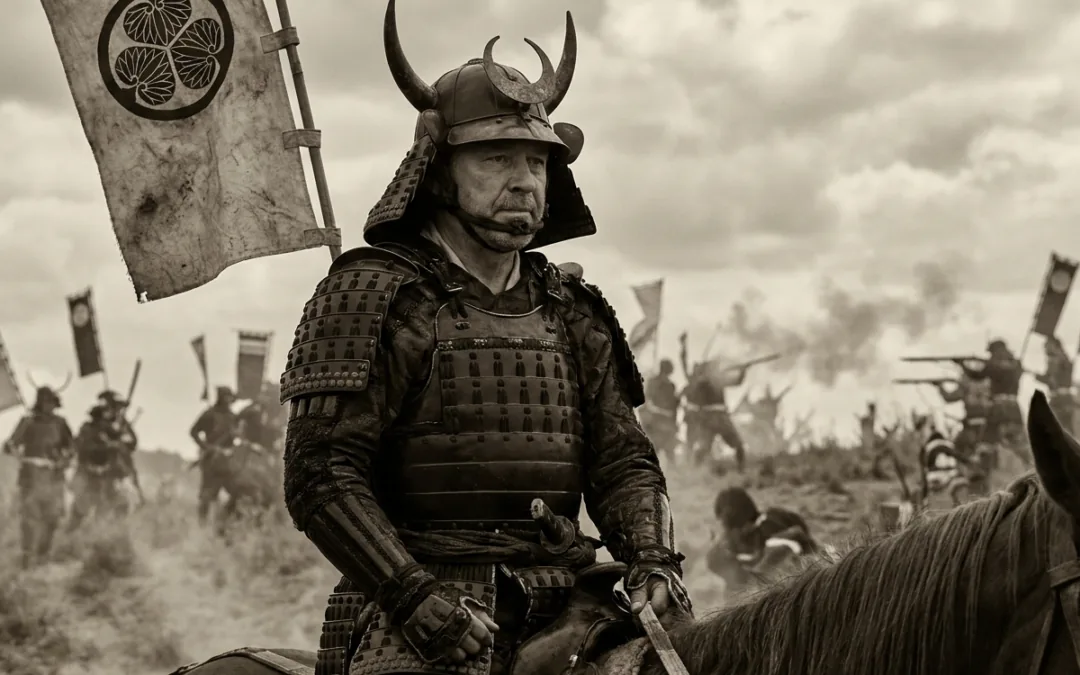
Tokugawa Ieyasu was born in 1543 in Mikawa province, the son of a minor warlord caught between greater powers, and spent his boyhood as a political hostage, first nearly in Oda hands and then for years under the Imagawa clan. That long captivity taught him the patience and watchfulness that would define his life. When Imagawa Yoshimoto was killed by Oda Nobunaga at Okehazama in 1560, Ieyasu broke free of his masters, took control of his ancestral lands, and bound himself in alliance to Nobunaga. He adopted the name Tokugawa in 1566 and built a hard, loyal domain in Mikawa.
For two decades he stood at Nobunaga’s side as the most reliable of his allies. He fought beside him at Nagashino in 1575 in the destruction of the Takeda cavalry, and he paid a brutal price for the alliance in 1579, when he was pressed to order the death of his own son and heir, Nobuyasu, to satisfy Nobunaga’s suspicions. After Nobunaga fell to betrayal in 1582, Ieyasu contended with the rising Toyotomi Hideyoshi, fought him to a costly draw at Komaki and Nagakute in 1584, and then bent rather than broke, accepting Hideyoshi’s supremacy. Moved to the Kantō plain, he made his seat at the fishing town of Edo and turned it into the foundation of his power. Edo today is known as Tokyo.
His patience outlasted them all. When Hideyoshi died in 1598, Ieyasu maneuvered against the Toyotomi loyalists and crushed them at Sekigahara in 1600, the battle that decided the fate of the country. He was named shogun in 1603 and founded a dynasty that would rule Japan for more than two and a half centuries. He passed the title to his son in 1605, yet kept the real authority in his own hands, and in the sieges of Osaka in 1614 and 1615, he destroyed the last of the Toyotomi to secure his house. He died in 1616 and was enshrined as a god at Nikkō, the quiet survivor who inherited the unified realm that Nobunaga and Hideyoshi had spent their lives fighting to build.