
Only one daimyo ever looked like a real threat to Oda Nobunaga's ambition to unify the country: Takeda Shingen of Kai. Shingen had already swallowed the provinces around his own, and Kyoto sat in his sights past all of them. To his southwest lay Mikawa, Tokugawa Ieyasu's territory. When the Imagawa clan collapsed after Okehazama, Takeda took Suruga outright and split Totomi with Tokugawa. In 1570, Tokugawa moved his headquarters to Hamamatsu in Totomi. Takeda read it as a provocation, and two years later, he proved it by crushing a Tokugawa force, reinforced by a few Oda troops, at Mikata ga hara. The following year, pressing his advantage, Shingen died. Disease, according to some accounts. A sniper's bullet at the siege of Noda Castle, according to others.
His son Takeda Katsuyori inherited the army and the ambition, not the loyalty. Katsuyori was a capable soldier, but he had no patience for the twenty-four generals and advisors his father had built the clan around, and he ignored them often enough that they stopped trusting his judgment. Rumor held that his mother had been something other than human, which did nothing to help him with men who already doubted him. Even so, in 1575, they followed him into Mikawa Province, arguing the whole way. Uesugi Kenshin, the Takeda clan's oldest enemy, sat to the north, and marching south meant marching without a right flank to cover their backs. It was Shingen's strategy that continued past Shingen's death. Katsuyori had one card his father hadn't: a traitor inside Tokugawa's own headquarters at Okazaki Castle, ready to open the gates from the inside.
The plan died before Katsuyori got there. Word of the conspiracy reached Tokugawa first; the traitor was executed, and Katsuyori turned his army away from Okazaki toward Tsukude, a castle that had once been his and no longer was. He bypassed that too, marched to Noda Castle on the Toyokawa River, and pushed downstream to raid three of Tokugawa's border castles. Two minor outposts of Yoshida Castle burned. Yoshida itself held. Katsuyori turned his army back upriver toward the last castle standing between him and the end of a campaign that had produced nothing worth the march: Nagashino.
Nagashino sat on a low cliff at the confluence of the Onagawa and Takigawa rivers, where the two joined to form the Toyokawa. It was small, roughly 250 by 330 meters, walled in stone with a dry moat around it, approachable only from the north and west. Two hundred and fifty men held it, Okudaira Sadamasa in command, backed by two hundred arquebuses and a single cannon. Katsuyori arrived on 14 June 1575 with thirty times that number and still couldn't take it. His men tried tunneling under the walls; the garrison countermined and stopped them cold. He sent samurai across the rivers on rafts; they got nowhere. He built siege towers; the garrison's gunners shot them apart. A general assault failed like everything before it. What was left, after four days of failure, was starvation, so Katsuyori settled in to wait the defenders out.
The garrison had one answer to a siege they couldn't outfight: a man named Torii Sune-emon, who volunteered to swim past the Takeda lines in the dark and carry word to Oda Nobunaga at Okazaki. He made it. Oda and Tokugawa were already moving, 38,000 men on the road, but Torii's report put urgency into the march. Torii didn't wait for them. He turned back toward Nagashino to deliver the news himself and was captured on the way. Katsuyori offered him a way to die usefully: call out to the garrison that no relief was coming, and beg for their surrender. Torii took the offer and broke it, shouting the truth instead, that Oda and Tokugawa were close and coming fast. He was crucified in front of the castle walls for it. His death did what his life hadn't managed: it put steel into men on both sides of the fight, the garrison holding on the strength of it, and more than a few among the Takeda who'd watched him die with something closer to respect than anger.
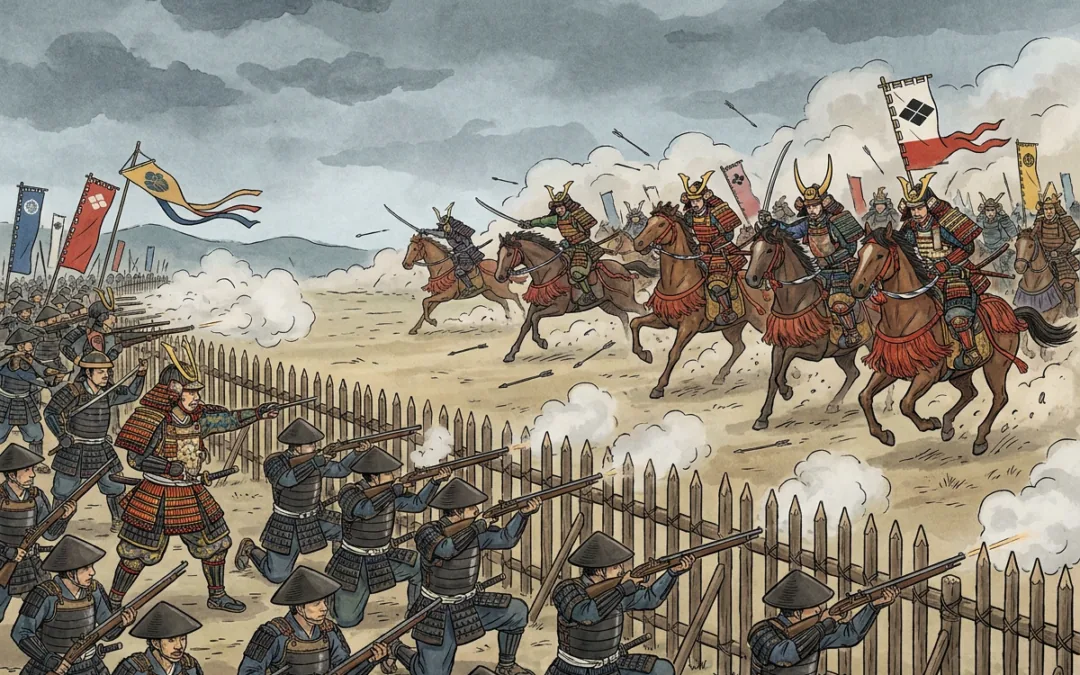
Oda didn't march directly to relieve the castle. He chose ground instead, three miles west on the Shitaragahara Plain, behind the Rengogawa River, and gambled that Katsuyori's temper would do the rest. On the evening of 27 June, his army formed a line running north to south, a hundred yards back from the river, high ground at Mt. Gambo anchoring the north end, and the Toyokawa River anchoring the south. The Rengogawa itself was no obstacle by size, shallow and narrow both, but the bank rising from its western side was steep enough to matter. Oda's men built a palisade fence between the river and their front line, broken into sections with gaps every fifty yards, wide enough for counterattacking infantry to pass through and tight enough to break a cavalry charge that tried to come through anywhere else. Behind that fence went the arquebusiers, and behind them, the rest of the army.
How many gunners stood behind that fence is the one question every account of this battle eventually runs into. Most later histories say three thousand. The number traces back to Oze Hoan's Shinchoki, written well after the fact; the earlier and more reliable Shincho-Ko ki puts the figure at one thousand. There's a second complication buried in either number: many of the men holding matchlocks that morning weren't Nobunaga's own troops at all, but soldiers loaned by his captains days before the battle, with no real time to drill in anything as complicated as rotating volley fire. Do the math on the frontage, roughly 1.25 miles, and either number produces the same picture: gunners spaced in clusters of thirty to fifty, close enough together either way that the arrangement itself doesn't settle the argument. The traditional account holds that Nobunaga placed three thousand matchlockmen three ranks deep behind the palisade, and that he put them under officers drawn from his own bodyguard, the horō-shū, a level of trust in ashigaru gunners that other daimyo of the period rarely extended.
Katsuyori did exactly what Oda had counted on him doing, against the advice of every general standing near him. He left three thousand men holding the lines at Nagashino Castle and led the remaining twelve thousand out through the night in four columns of three thousand each, marching through rain he seemed to think would work in his favor: wet powder, useless matchlocks. Oda had already learned that lesson the hard way at Nagashima and had ordered his gunners to keep their powder and fuses dry no matter what the weather did. What the rain actually accomplished was turning the low ground along the Rengogawa into mud, and it did that to both armies equally. Takeda's forces came up along the tree line, two to four hundred yards from the palisade, and formed three commands abreast, each built around a thousand cavalry with infantry and support behind them. Katsuyori held the center command in reserve behind the middle line.
While Takeda's army was still moving into position, Oda convened his own war council and made one more decision: a strike force of three thousand men, five hundred of them arquebusiers, sent to hit the troops Katsuyori had left behind at Nagashino. A rear attack timed to land the same morning Katsuyori committed his main force elsewhere would cost the Takeda army its security at exactly the moment it could least afford to lose it. The target was a thousand-man garrison on Mt. Tobigasuyama, across the Omagawa River from the castle.
By five in the morning, Takeda's forces held the tree line. Katsuyori's read on the ground was straightforward: the distance from the woods to the palisade was short enough that his cavalry could close it fast, before the gunners had time to reload between volleys. His strongest unit, positioned on the far left, was meant to swing wide around the end of the fence line and roll up Oda's flank from the side.
The drums started at six, and the charge began. Nobunaga had told his gunners to hold fire until the Takeda horse closed to fifty meters, so the run from the trees to the river went unopposed. It was the riverbank that broke the charge's rhythm, the horses fighting for footing on the steep western bank, momentum bleeding out of the attack at the one place it couldn't afford to stall. Oda's gunners used the delay. Volley fire opened up, rank rotating behind rank, at a range close enough that an arquebus ball would go through samurai armor and certainly through an unarmored horse. The first wave took that fire, standing nearly still at the water's edge. What survived it tried to rebuild, speed-climbing a slope that only got steeper the closer it came to the guns, and the closer it came, the worse the damage got. Modern reconstructions of the weapon suggest that an experienced gunner could put five shots out of five into a man-sized target at thirty meters, compared to one in five at fifty. That means the first volley caught men and horses barely moving, the second caught them picking up speed, and the third landed close enough to be nearly point-blank. No one recorded how many died in that first charge, but whatever unit cohesion the Takeda cavalry had going in didn't survive the ride to the fence. The handful who found gaps in the palisade ran into odds no individual horseman could beat, and what was left of the charge fell back.
More charges followed through the morning, the fighting collapsing into hand-to-hand combat each time Oda's men came out from behind the palisade to meet it. That held until one in the afternoon, when Nobunaga called his men back behind the fence and the Takeda lines, and began to pull back. Nobunaga didn't let them go quietly. He ordered pursuit, and despite a rearguard action that cost the Takeda generals dearly to organize, Oda's cavalry ran down and killed samurai the length of the retreat.
Not every historian accepts this account in its entirety. Mitsuo Kure, in his history of the samurai, argues that mounted archers had dominated Japanese warfare centuries earlier, in the Heian and Kamakura periods, but that tactics had already shifted away from mounted assault specifically to avoid gunfire well before Nagashino. In Kure's reading, the Takeda force dismounted to fight on foot at Shitaragahara, and the real killer that day was terrain: ground too muddy for any cavalry charge to survive, reinforced by ditches and earthworks behind the palisade fence, not the fence and the guns alone. He points out that none of the four men most central to the battle, Nobunaga, Hideyoshi, Tokugawa, or Katsuyori himself, ever singled out arquebus fire as decisive in their own accounts, arguing that concentrated gunfire wasn't novel enough in Japanese warfare by 1575 to be worth mentioning. Lamers, who did more than anyone to undercut the traditional gunner count, still comes down on the side of the standard story where cavalry is concerned: Katsuyori threw away the one advantage speed gave him by charging straight into a prepared defense, spending his men against superior firepower for no return.
Weigh it out, and the traditional account still holds up best. Katsuyori's temperament was well documented; his cavalry's reputation was earned before this battle and not invented after it, and a frontal assault against even a thousand matchlocks, across a rising riverbank, into a braced defensive line, would have been close to suicidal whether the ground was muddy or not. The mud made a bad plan worse. It didn't create the disaster on its own. Casualty estimates for the Takeda side run from several thousand up to ten thousand; the Oda-Tokugawa side lost something closer to six thousand. The diversion against Mt. Tobigasuyama succeeded; the isolated garrison there was overrun, while Nagashino's own defenders sallied out to finish off what remained outside their walls.
What happened at Nagashino was, in the language a modern staff officer would use, a meeting engagement that grew out of an approach march. Ordinarily, the side still moving presses the attack. Here, Oda's army stopped and dug in instead, choosing ground built to punish an impulsive opponent and then waiting for that opponent to prove them right. The river did the first job of breaking the attack's momentum; the palisade did the second. Nobunaga issued no orders for spoiling attacks or early sallies, only to hold the line until the attackers had spent themselves against it, and then to run down whatever was left once they broke. Having gutted the Takeda army where it stood, Oda and Tokugawa didn't wait to consolidate. They sent their men out from the palisade immediately, turning a defensive win into a rout.