
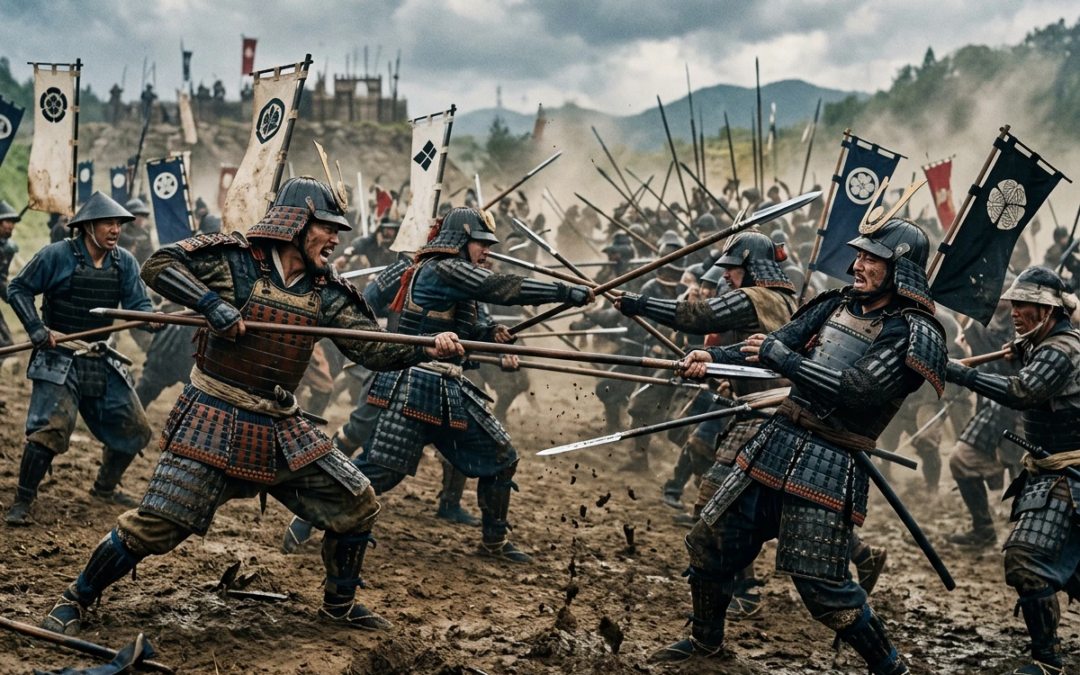
Picture a samurai and you picture a sword. On a real Sengoku battlefield, the man in front of you was more likely holding a spear.
The weapon was the yari: a long wooden shaft with a straight blade fixed to the end, built for the thrust. Simple to make, simple to hold, and hard to stand in front of. For most of the sixteenth century it was the weapon that mattered when two armies met in the open. The sword stayed on the hip, drawn when the spear was gone or the fight had closed to arm's length.
That's the part the movies leave out. The katana became the symbol. The yari did the work.
Why the spear beat the sword
Japanese warfare changed shape over a few generations. Early battles turned on mounted archers, a smaller number of skilled men trading arrows and riding down stragglers. By the Sengoku period the armies were larger, the ranks were fuller, and a single warrior's skill counted for less than the discipline of the line he stood in.
The yari fit that math exactly.
A spear reaches. A man with two meters of shaft strikes a man with a sword before the sword is close enough to answer. Line a hundred of those men up shoulder to shoulder and you have something a swordsman cannot walk into. It kept distance from the enemy and held the line together, even when the line was made of men who had never trained a day with a blade.
That last point decided its spread. A sword takes years. A spear takes weeks. When you are arming farmers by the thousand, weeks is the number you can afford.
The wall of spears
Those farmers were the ashigaru, the foot soldiers who made up the bulk of most armies. They were recruited off the land, handed a weapon, and put in a row. The yari was the weapon that survived that plan.
Stand enough of them together, blades out, and the formation had a name: yari-busuma, the spear wall. It was aimed at cavalry above all. A horse will not run itself onto a hedge of points, whatever the rider wants; the animal reads the ground and refuses. A charge that would have scattered loose men broke against a disciplined row of spears and stalled. The men behind the points did the rest.
Nobunaga's line
Oda Nobunaga is remembered for guns. At Nagashino in 1575 his arquebus volleys are the thing the history books frame, rank after rank firing into the Takeda cavalry.
The spears are the reason the guns kept firing. Behind and between the firing lines stood spearmen whose job was to stop any horseman who reached the position and to hold the ground while the next volley loaded. Take the spears out of that picture and the muskets are a single shot away from being overrun. Nobunaga's win at Nagashino was a system, and the yari was one of the parts that made the system stand.
Sword, naginata, and how the yari took the field
The sword was never useless. It was the wrong tool for most of the day. Close quarters and single combat belonged to the blade; distance and the press of a mass battle belonged to the spear. A well-run army carried both, plus bows for range and, later, firearms for weight of fire, and used each where it earned its place.
The yari also had to beat out an older pole weapon to get there. Before it, the naginata ran the field: a curved blade on a shaft, swung in wide arcs, made for cutting men and horses down as it passed. That arc was the problem. In a loose fight between mounted duelists it was deadly. Pack men into tight ranks and a swinging naginata is as much a threat to the man beside you as to the enemy. The thrust of a yari goes forward and only forward. In a crowd, forward is the only safe direction.
So the samurai changed weapons, and not because they wanted to. They gave up a blade they had trained on and favored because group warfare left them no choice. From the Edo period on, with the great battles over, the naginata drifted out of the man's armory and became known as a woman's weapon, kept in the home for defense.
Pike and lance, the yari's cousins
Most cultures built a spear, because the spear is one of the oldest ideas in war. Europe had two versions worth naming. The pike was a very long infantry spear, held in dense blocks of foot soldiers. The lance was the horseman's weapon, couched under the arm at the charge.
The yari lands on the pike's side of that line. It was an infantryman's tool, made to work in a formation rather than in a duel, which is why it grew so tied to group tactics. The lance was about one rider and his momentum. The yari was about a hundred men and their nerve.
The kinds of yari
The basic shape stayed simple. The variations came from the job.
- Su-yari, the straight spear: one point, made to thrust. The common form.
- Jumonji-yari, the cross spear: a central blade with two smaller ones set crosswise, good for hooking, parrying, and pulling a rider down.
- Kama-yari, the hooked spear: a side hook for catching a weapon or a limb.
- Nagae-yari, the long spear: overlong shafts carried by ashigaru in mass formation, some of them well past four meters.
Those side blades did more than they look like they could. A cross-headed yari could catch an incoming weapon and bind it, which turned a thrusting stick into something that could defend as well as strike. A shorter yari, around two meters, was made for precise thrusting and became the foundation of martial schools that still teach the movements today. A long one was heavy enough that men swung it down like a club as often as they aimed it, letting weight do the work in the crush of a formation.
The Tonbokiri
The most famous yari in Japan belonged to Honda Tadakatsu, one of Tokugawa Ieyasu's senior retainers. It carried a broad, bamboo-leaf-shaped Sasaho blade forged by the smith Fujiwara Masazane, and its proper name is the plain description of what it is: a spear, signed, made by Masazane.
Nobody calls it that. They call it Tonbokiri, the Dragonfly Cutter.
The name comes from a story. A dragonfly landed on the standing blade and fell in two halves, cut clean by the edge with no hand behind it. Whether it happened is beside the point; men repeated it because it said the thing they wanted said about the weapon and the man who carried it. The blade ran about 43.7 centimeters on a shaft near six meters long in Tadakatsu's day, later cut down to a more usable length once the wars that called for six meters of spear were finished.
Kato Kiyomasa carried a spear. So did Sanada Yukimura. The men whose names outlasted the period were spearmen as often as they were swordsmen. The sword got the statue. The yari got the century.